Landing page or full website: what does your business need?
Choose the right scope around your offer, your customers and the questions they need answered. Includes a practical decision table.
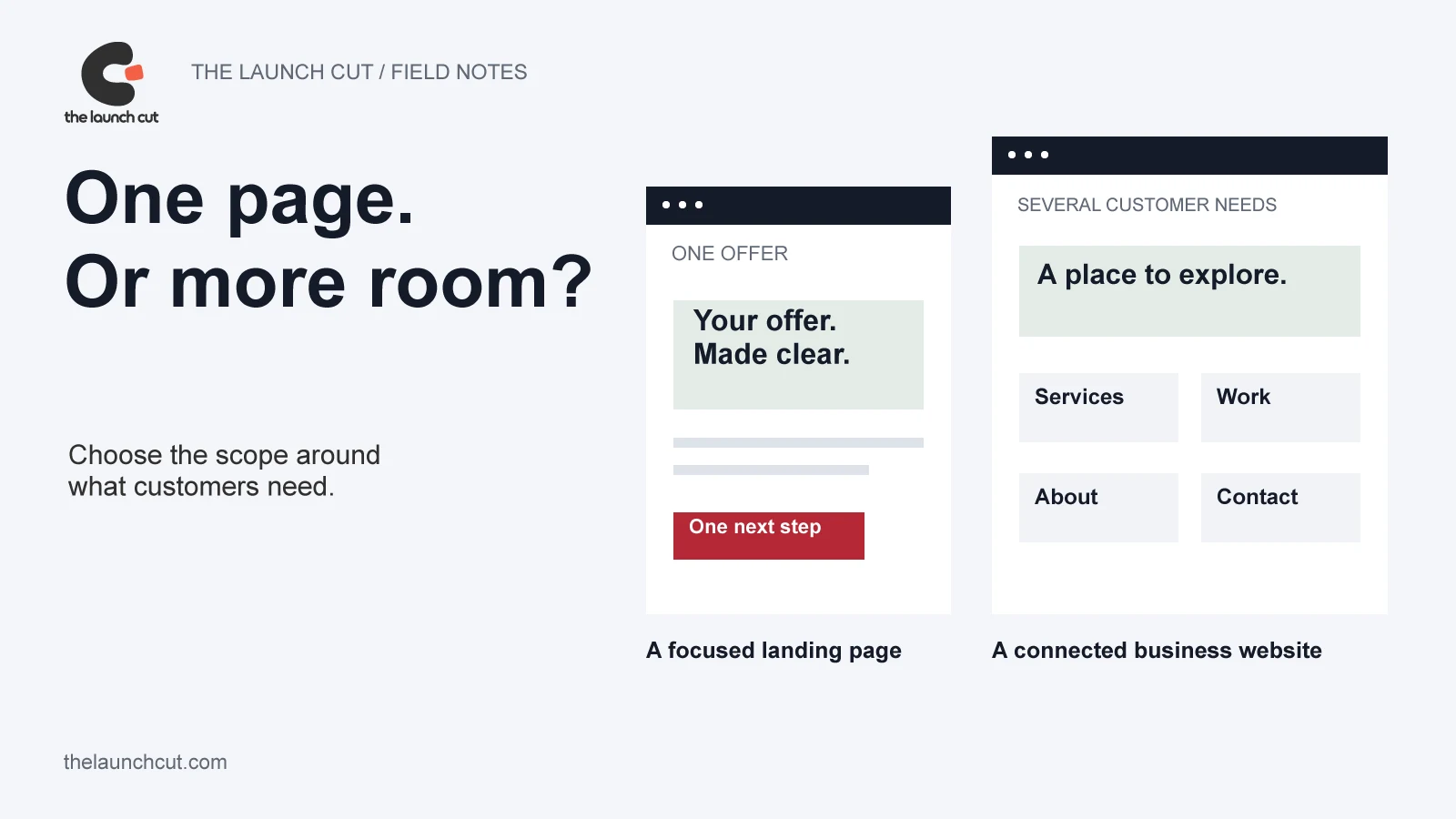
Start with the decision your customer needs to make.
A focused landing page is a sensible starting point when you have one offer, one audience and one main action. A full website makes more room for different services, detailed work, useful guides and the questions people ask before contacting you.
The choice is about the customer journey. A long one-page site can still be confusing, and a five-page website can be easy to navigate. Decide what visitors need to understand before deciding how many pages to build.
What is a landing page, and how is it different from a website?
In a design brief, a landing page usually means a focused page built around a particular offer or campaign. Its sections might introduce the offer, explain the benefits, show relevant proof, answer objections and lead to an enquiry or booking.
A business website is a collection of connected pages. A visitor may arrive on the homepage, a service page, a project example or a useful article. Navigation helps them move between those pages as their questions change.
These are not mutually exclusive. A full website can include campaign landing pages. In advertising, Google defines a landing page as the page someone reaches after clicking an ad; an existing service page can therefore be a landing page too.
A practical way to choose your scope.
| Question | Focused landing page | Full website |
|---|---|---|
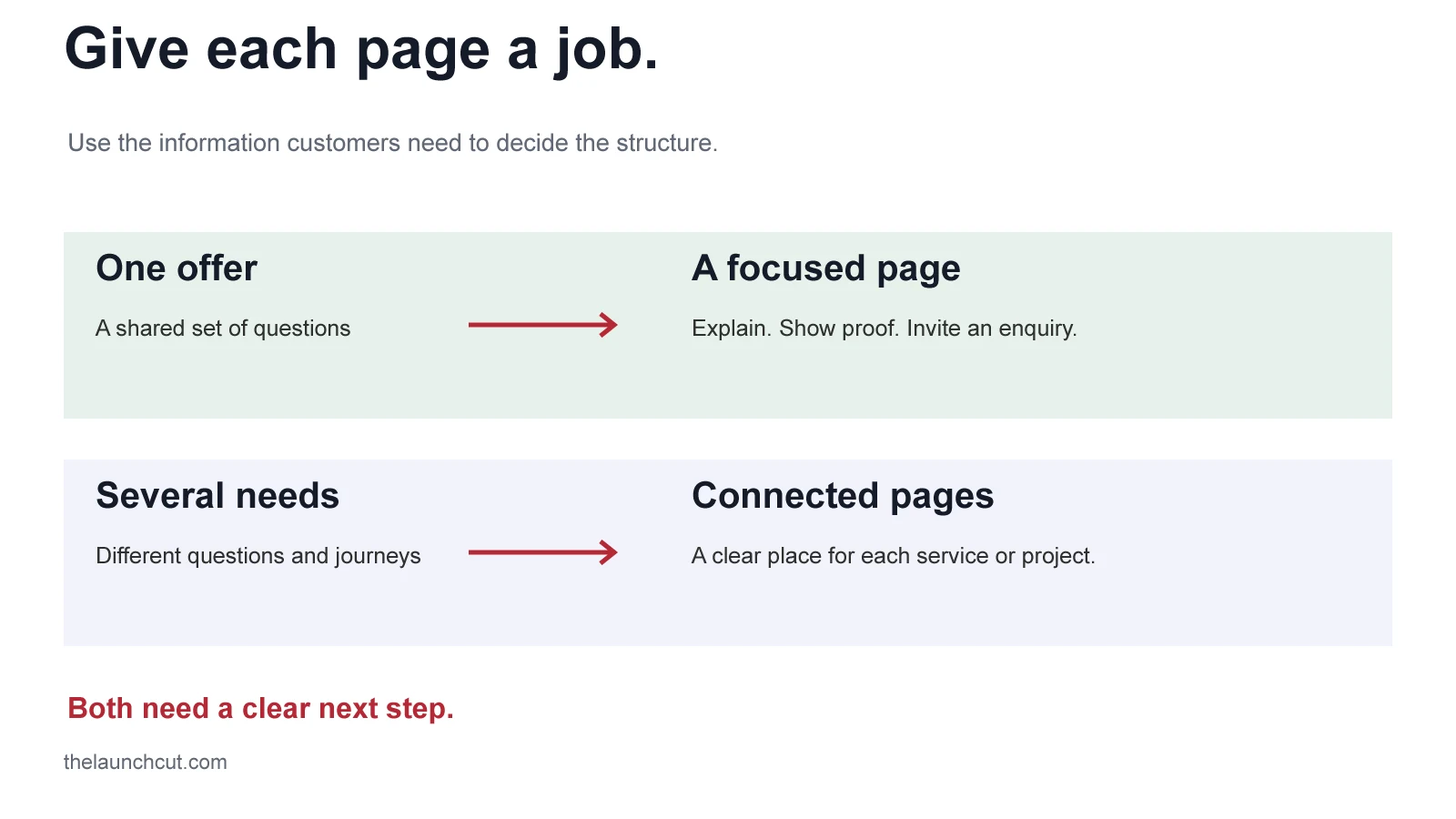
| What are you promoting? | One service, offer, event or campaign. | Several services, audiences or locations with genuinely different information. |
| What must a visitor understand? | A short, shared set of questions. | Different questions depending on what they need. |
| Where will people arrive from? | A focused link in an ad, email, social post or referral. | Search, referrals and browsing across services and resources. |
| How much work can you show? | A small selection that supports one offer. | A portfolio that benefits from separate projects or categories. |
| What will change over time? | The offer and a few supporting details. | Services, project pages, articles or several content areas. |
If your answers are mixed, start with a small website and a focused service page. You do not need a large site simply because you have more than one thing to explain.
What this could look like for your business.
A coaching institute
A page promoting one weekend workshop could explain the topic, teacher, schedule, fee and registration process. An institute with several programmes may need separate course pages so parents and students can compare eligibility, subjects and timetables.
Our Northstar Academy design sample demonstrates clear programme discovery. Use it to discuss the experience you want, rather than treating its sample content as your own.
A car detailing business
One page can be enough to introduce a small set of treatments, show the finish customers can expect, explain the process and invite a booking enquiry. Separate treatment pages become useful when the services need different explanations, preparation instructions or pricing factors.
The Apex Detail sample shows how a focused service experience can work.
An interior designer or architect
A portfolio-led introduction can establish the visual direction. If each project has a distinct brief, process and set of images, dedicated project pages give those details room. A striking scroll experience is useful only when visitors can still find the work, understand the service and contact the studio.
Explore Form & Field for an interactive architecture design direction. These three sites are original design samples, not client case studies.
What about SEO, cost and maintenance?
Neither format automatically ranks better. More pages create more places to answer distinct questions, but each page needs useful content and a reason to exist. One clear service page is preferable to several near-identical pages with different headings.
For a multi-page site, give pages descriptive titles, connect them with useful links and make the important information easy to find. These principles align with Google’s SEO Starter Guide. They help make content understandable; they do not promise a search position.
Cost follows the work involved: content, design, forms, integrations, development, testing and handover. A highly customised landing page may take more work than a simple multi-page site. Ask for a scope comparison rather than assuming that one page means a particular price.
Also agree who updates the content, where enquiries go, and how hosting, domain renewals and ongoing support are handled. These responsibilities matter for both options.
Write these six answers before briefing a designer.
- Who is the main visitor, and how will they reach the page?
- What do you want that person to do next?
- Which questions must be answered before they take that step?
- Which services or projects genuinely need their own explanation?
- What content, photography and examples can you supply?
- Who will manage updates after launch?
Those answers give a designer enough context to recommend a sensible starting scope. You can add pages later when there is a clear customer need for them.
Need help choosing the right starting point?
Our website design and development service covers focused landing pages and business websites. Share your offer and the action you want visitors to take.
Discuss your website